Finally, we’ve made it through 1997! This is my final ’97 album review, but I plan on posting the best and worst of the year in the next few weeks. I hope you enjoy the read, and thanks for time traveling with me.
By 1997, Puff Daddy and his Bad Boy Empire had begun to infiltrate hip-hop with an overabundance of bling talk and material gluttony. Often dubbed the Shiny Suit era, this new feel of hip-hop was commercially successful, which would make all other record labels and rappers begin to follow suit, aka copycats. But there will always be a few who choose to go against the status quo.
Rawkus Records was founded by two Brown University students (Brian Brater and Jarret Meyer) in 1995. Recognized by its black razor logo, it has been heralded by some as the last great hip-hop label for upholding the music’s organic integrity and helping spark the careers of legends like Black Star, Pharoahe Monch (post-Organized Konfusion), and Eminem. Rawkus laid its foundation in ’97, releasing the label’s inaugural album, Company Flow’s Funcrusher Plus, in July, and the subject of today’s post, Soundbombing, in November.
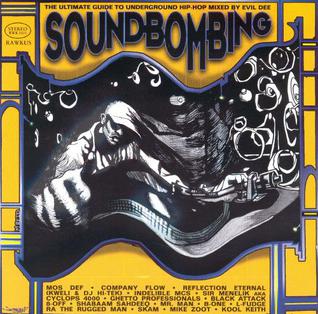
Soundbombing is a compilation album hosted by DJ Evil Dee of Da Beatminerz, featuring a bunch of up-and-coming New York-based emcees and one wily veteran who has reinvented himself a thousand times throughout his lengthy career (more on that later). As expected, the album wasn’t a commercial success, but it was a critical darling, receiving mostly positive reviews.
I bought a used CD copy of Soundbombing over a decade ago, and I may have listened to it once all the way through, which isn’t enough to form a solid opinion. It almost slipped through the cracks of my not-so-foolproof blog spreadsheet until one of my faithful readers (what up, Tony?!) asked me if I owned it. I remembered I did, and here we are today.
Intro – Our host for the evening (DJ Evil Dee) welcomes us all to the album and hits us with his signature tagline. This is followed by rugged drums, an ill jazz piano loop, and a short refrain from a group called Brick City Kids.
Flipside – R.A. the Rugged Man is one of those rappers I don’t know much about, but every time I hear him rap, I’m thoroughly entertained. He continues to entertain on this one-verse wonder, expressing his disappointment with the music industry and pretty much everybody on planet Earth. He’s backed by a muddy musical bed that suits his gutter delivery and flow well. I’m not sure who produced the track, as the liner notes hi-lariously state, “All information concerning R.A. is currently unknown.”
Fire In Which You Burn – Indelible MCs was a short-lived supergroup consisting of Company Flow (El-P, Big Juss, and Mr. Len), J-Treds, and Juggaknots (Breezly Brewin, Queen Herawin, and Buddy Slim), and I use the term “super” loosely. Only Breezly Brewin, J-Treds, Big Juss, and El-P rap on this track, and they all make passable performances, but their undynamic vocal tones get lost in El-P’s ear-straining, stale instrumental.
Lune TNS – This one is credited to Company Flow, but it’s really a Big Juss solo joint. His instrumental sounds like the soundtrack for a white-coated mad scientist in his lab mixing formulas in beakers. Juss uses the misty backdrop to list a bunch of New York City taggers’ aliases and gives the listeners who don’t get it a big middle finger. I thought it was cool.
Nightwork – I was introduced to Sir Menelik via Dr. Octagonecologyst, as he played Keith’s off-the-wall sidekick, Chewbacca Uncircumcised. He makes his first appearance of the evening as Cyclops 4000, spraying El-P’s bouncy boom-bap with a clip full of abstractions. I can’t follow half of what Menelik is saying on this track, but his verbal word salad over El-P’s gritty production was intriguing.
Arabian Nights – In the mid-nineties, Nick Wiz was quietly putting together an impressive production resume (with production credits for Miilkbone, Mad Skillz, Rakim, Cella Dwellas, and Chubb Rock records), and this is a nice addition to his discography. He crafts a sleek banger for Shabaam Shadeeq (who sounds heavily influenced by Nas) to paint with slick urban slang. This was fire.
Fortified Live – Speaking of fire, Talib Kweli, Mos Def, and Mr. Man from Bush Babees keep the blaze going on this intellectual cipher session. Everyone knows Talib and Mos (who in 1997 were revving up to release their debut Black Star album the following year) are elite-level emcees, but Mr. Man never got the proper chance to shine in his rap career. He takes full advantage of this opportunity, out-rapping his contemporaries (who sound great in their own right) and Hi-Tek’s ill-ass beat. His “I’ll cut your ass in half and leave you with a semicolon” bar was ridiculously witty.
Show Me Your Gratitude – I’ve never heard of L-Fudge before this record, and this was a horrible introduction. I hate his choppy flow, and the whistling beat (credited to a Rich Boogie) was as annoying as listening to Loren LoRosa stumble through a segment of The Latest on The Breakfast Club.
Till My Heart Stops – Side One of Soundbombing ends with an R.A. the Rugged Man/8-Off duet. I first became familiar with 8-Off (aka Agallah) as a producer, producing tracks for the likes of Onyx, PMD, and EPMD. He licks his rapping chops on this record, and his raspy voice, paired with R.A.’s humorous, semi-psychotic gruffness, makes for an entertaining listen over the darkly emotional instrumental.
Freestyle – After Evil Dee welcomes us back for side two of Soundbombing, Talib Kweli does a little riffing over some cool jazzy chords. That quickly comes to an end when Shawn J. Period’s triumphant loop drops and Talib and Mos hot potato the mic with off-the-top freestyle rhymes. The bars are pretty solid, and we find out that Talib once went by the alias of Genesis. I’m glad he chose to go with his government.
So Intelligent – The Dr. Octagonecologyst duo (Kool Keith, the wily vet I mentioned in the opening, and Sir Menelik) reunites on this record, and if “Nightwork” was a word salad, this shit is a vernacular full-course meal. I couldn’t decipher much of the oddball emcee’s nerdy composition, but I still enjoyed listening to their heavily coded abstractions and the ironically simple hook. I didn’t care for the boring backdrop, but there is a remix of this record with a much livelier and harder instrumental.
Empire Staters – The rapper on this track, B-One (not to be confused with KRS-One), shares his perspective on life from a NYC hustler’s point of view. He sounds like he may have fallen from the Mobb Deep tree and rolled down a few hills away from it, and I say that in the most complimentary way possible. The gully drums and unnerving chords (credited to Chuckie Madness) paint the nighttime New York City streets as unsafe, while also igniting my anxiety in the most entertaining way possible.
If You Can Huh… – Shawn J. Period throws Mos Def some ole beautiful shit to drop jewels over, and he doesn’t disappoint. By the way, I love the song title and hook; I have to start using that line on my kids when they “Huh?” at me.
Universal Magnetic – Mos starts this off by kicking a mediocre alphabet rhyme over a basic drumbeat, and oddly skips over J and ends at P. Things get better from there, as The Mighty Mos takes off the introspective conscious cap he wore on the previous track to get into some light-hearted emceeing (I love the Eddie Murphy Delirious and Raw references). Shawn J backs Black Dante’s bars with warm vibrations and a cloudy melody that I thoroughly enjoyed. This concludes an impressive two-piece Mos Def/Shawn J Period suite.
What If? – L-Fudge gets another shot, but this time he brings in plenty of help. He’s joined by Mike Zoot, Talib Kweli, Shabaam Shadeeq, and Skam, and the five of them have plenty of questions to ask over DJ Spinna’s anxious instrumental. This was decent, but it’s got nothing on “The Questions” (Mos Def and Common), “21 Questions” (50 Cent), or Jadakiss’ “Why” (coincidentally, Jada also made a song called “What If,” which was an obvious attempt to recapture the success of “Why;” it didn’t, but that track was also stronger than this record).
My Crown – I found a 12” vinyl copy of this record a few years ago. I knew nothing about the record or Black Attack, but bought it for a few bucks on the strength of the Rawkus Records logo printed on the label. It turned out to be an inexpensive gamble that paid off. Black Attack presents as a competent emcee with smooth verbals, and the Ghetto Professionals’ tough backdrop makes his bars sound even sharper (those big vibrant horns sound absolutely amazing). Side note: the B-side on the 12” is a record called “Correct Technique” featuring Problemz. It’s a dope joint that uses the same instrumental that Talib and Mos rapped over on their freestyle that kicks off side two of the album.
2000 Seasons – The last track of the evening goes to Reflection Eternal (which consisted of Talib Kweli on the mic and DJ Hi-Tek on the beats). Talib spews plenty of food for thought over the course of two verses, and Hi-Tek’s elegant jazz break paired with strong drums makes TK’s brainy nutrients easier to digest. This delicious closing track ends with Evil Dee doing a little promo for Rawkus and himself.
In the book of Mathew, Jesus shares a parable about the wise builder who built his house on solid rock: “Though the rain comes in torrents and the floodwaters rise and the winds beat against that house, it won’t collapse because it is built on bedrock” (Matt 7:25). Compared to the foolish person who built their house on sand, and “When the rain and floods come and the winds beat against that house, it will collapse with a mighty crash” (Matt 7:27). Somehow, Rawkus knew that “seventy-four minutes of dung flavored Now & Later and ass crack Oreos” would make a great substitution for bedrock.
Soundbombing is a well-orchestrated mixtape that avoids the glam, glitz, and all the other flashy bullshit so prevalent in mainstream hip-hop at the time. It’s seventeen tracks of hungry, relatively unknown (minus Kool Keith) emcees showcasing their talent over raw boom-bap beats, all woven together by the charismatic DJ Evil Dee’s silly commentary and infectious tagline (“Evil Dee is on the mix, come on kick it!”).
Like most compilation projects, Soundbombing has a few lackluster moments. But as a whole, it’s an entertaining backpacker’s delight that has aged well.
-Deedub
Follow me on Instagram @damontimeisillmatic